A miter saw transforms how you approach trim work, framing, and angled cuts. DeWalt’s 10-inch models have earned their place in workshops from basement hobbyists to job-site pros, offering the sweet spot between power, capacity, and price. Unlike 12-inch saws that eat bench space and budget, a quality 10-inch delivers clean crosscuts on 2×6 framing lumber, crown molding, and hardwood trim without the bulk. If you’re upgrading from a circular saw or ready to move past borrowed tools, understanding what sets DeWalt’s 10-inch lineup apart will help you choose the right model and get the most from it.
Table of Contents
ToggleKey Takeaways
- A DeWalt 10-inch miter saw balances power, capacity, and cost by handling most residential trim work, framing, and deck projects without the bulk and expense of 12-inch models.
- The DWS779 sliding compound saw and upgraded DWS780 with XPS cross-cut positioning both extend capacity to 2×12 boards at 90 degrees, with the DWS780’s auto-adjusting LED shadow system eliminating calibration drift.
- DeWalt’s 15-amp motors deliver 5,000 RPM through stainless steel detent plates and electric brakes that stop the blade in two seconds, ensuring accuracy and safety for fast production work.
- Proper setup—mounting to a stable bench at 36 inches, squaring the blade to the fence, and supporting long boards—directly impacts cut quality and prevents kickback and binding.
- Maintenance every 10–15 cutting hours (blade cleaning, lubrication every 20 hours, and dull-blade checks) keeps your DeWalt 10-inch miter saw performing cleanly and extends tool life.
- Common DIY projects like baseboard installation, crown molding compound cuts, deck framing, and picture frame assembly are all practical applications where a miter saw becomes indispensable for precise angles and uniform lengths.
Why Choose a DeWalt 10 Inch Miter Saw for Your Workshop
DeWalt built its reputation on jobsite durability, and their 10-inch miter saws inherit that toughness. The 15-amp motors on most models spin 10-inch carbide blades at 5,000 RPM, generating enough torque for dense hardwoods like oak or maple without bogging down mid-cut. For most DIYers, a 10-inch blade handles the bulk of residential projects, baseboards, chair rails, door casings, deck boards, and picture frames.
The crosscut capacity matters more than blade diameter for typical home projects. DeWalt’s 10-inch saws slice through 2×6 dimensional lumber at 90 degrees and 2×4 stock at 45-degree miters, covering framing, deck construction, and trim carpentry. If you’re not routinely cutting 4×4 posts or wide crown molding laid flat, the 10-inch format saves money and counter space compared to 12-inch models.
DeWalt’s dust collection systems capture roughly 75% of sawdust when paired with a shop vac, keeping your work surface visible and your lungs cleaner. The dust ports fit standard 1-¼ inch and 2-½ inch hoses. Integrated LED cutline lights cast shadows along the blade path, eliminating guesswork on narrow trim pieces where pencil marks disappear in the kerf.
Top DeWalt 10 Inch Miter Saw Models Compared
DeWalt’s current 10-inch lineup centers on compound and sliding compound saws. The DWS713 compound miter saw (non-sliding) handles 2×8 lumber at 90 degrees with its compact footprint, ideal for trim work where you don’t need the extended crosscut capacity. It weighs 37 pounds, making it portable enough for second-floor remodels or attic projects.
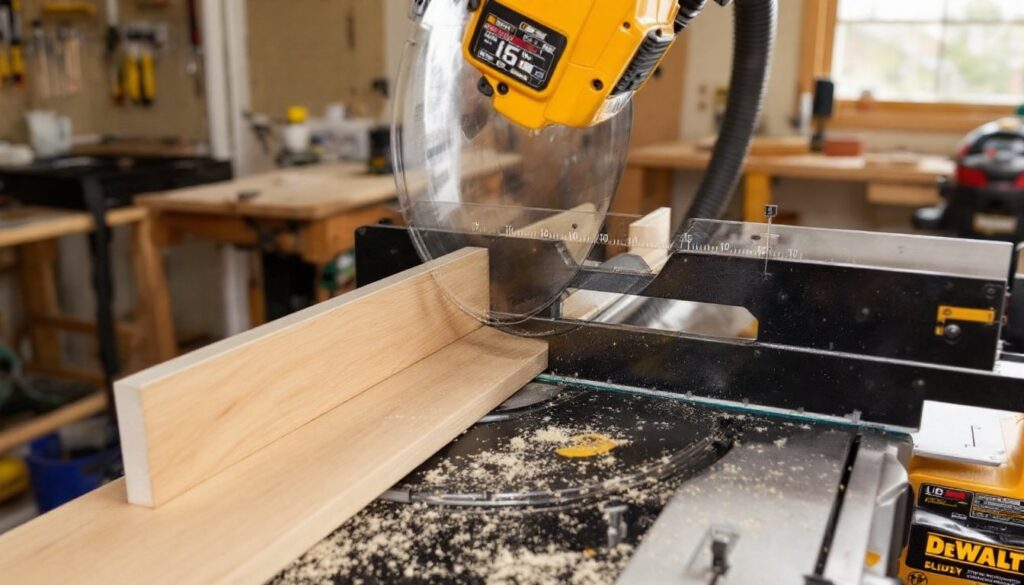
The DWS779 sliding compound miter saw extends crosscut capacity to 2×12 boards at 90 degrees and 2×8 stock at 45-degree miters, thanks to its dual horizontal steel rails. The sliding head also cuts nested crown molding up to 6-¾ inches. It includes ten positive miter stops at common angles (0°, 15°, 22.5°, 31.6°, 45°) with a 50-degree range left and right. At 56 pounds, it’s bench-mounted rather than hauled between rooms.
DWS779 vs DWS780: Which Model Is Right for You?
The DWS780 shares the DWS779’s rail system and cut capacities but adds DeWalt’s XPS cross-cut positioning system, an LED array that projects the blade’s shadow onto the workpiece rather than using a traditional laser. No calibration drift, no dead batteries, and the cutline adjusts automatically as the blade wears. Many home improvement projects reviewed extensively confirm the XPS system eliminates the gap between where the laser points and where a slightly warped blade actually cuts.
The DWS780 also upgrades to a cam-lock miter handle with detent override, allowing micro-adjustments without lifting the handle from its detent slot. If your work includes precise angles for polygonal furniture or nested crown, the DWS780’s system shaves time off test cuts. The price gap runs $150–$200 depending on sales, so budget-conscious DIYers who can calibrate angles with test scraps often stick with the DWS779.
Key Features That Make DeWalt Miter Saws Stand Out
Stainless steel miter detent plates resist wear better than aluminum, maintaining crisp stops after thousands of cuts. The detent override button lets you swing past preset angles for custom work, bevel cuts on stair skirts or compound miters for octagonal planters, without fighting the detent spring.
DeWalt’s tall sliding fences support crown molding up to 6-¾ inches nested (positioned upside-down against the fence as it sits on a wall) and baseboard up to 6-½ inches vertically. The fences slide outward to accommodate wider stock, and many models include fence extensions that clamp on for long boards. When cutting 8-foot baseboards, the extensions keep both ends supported so the board doesn’t tip mid-cut.
The bevel range on most 10-inch DeWalts runs 0° to 48° left and 0° to 48° right, with detent stops at 0°, 22.5°, 33.9°, and 45°. That 33.9-degree stop matches the spring angle for crown molding, eliminating math when cutting compound miters. The bevel locks with a single knob at the rear, and the scale includes 1-degree graduations for fine-tuning.
Electric brakes stop the blade within two seconds after releasing the trigger, critical for production work where you’re not waiting ten seconds between cuts. It also improves safety when you’re working fast.
Setting Up and Using Your DeWalt 10 Inch Miter Saw
Bolt the saw to a stable workbench or miter saw stand rated for at least 300 pounds. Sliding models generate lateral force during cuts: a wobbly base throws off accuracy and risks kickback. If mounting to a plywood bench top, use ¼-inch lag bolts through the saw’s base holes into ¾-inch plywood backed by 2×4 cleats underneath.
Set the saw at a comfortable height, typically 36 inches from floor to table for most users. Your elbows should bend roughly 90 degrees when holding the handle with the blade lowered. Too high and you lose leverage: too low and you’re hunched over, risking back strain during long sessions.
Square the blade to the fence before your first cut. Place a framing square against the fence and blade body (not the teeth). If there’s a gap, loosen the bevel lock and adjust the 0-degree bevel stop screw until the blade sits perpendicular. Lock it down and recheck. Repeat for the miter setting using the square against the fence and table.
For accurate cuts, let the blade reach full speed, about one second, before contacting wood. Feed slowly through dense hardwoods: forcing the cut burns the wood and overheats the blade. After the cut, release the trigger and wait for the blade to stop completely before lifting it. Reaching over a spinning blade is how fingers get shortened.
Support long boards with roller stands or an outfeed table. An unsupported board tips as you near the end of the cut, shifting the angle and potentially binding the blade. Position supports so the board stays level throughout the cut.
Essential Safety Tips and Maintenance Practices
Wear safety glasses rated ANSI Z87.1 and hearing protection, miter saws peak around 100 decibels, enough to cause permanent hearing damage with repeated exposure. A dust mask rated N95 or better matters more than most DIYers think: hardwood dust and MDF particles are carcinogens with long-term exposure. If you’re cutting treated lumber, upgrade to a respirator with P100 filters.
Keep hands at least six inches from the blade path. Use the saw’s clamp or a separate bar clamp to secure narrow or small pieces, never hold them freehand. If the cutoff piece is shorter than your palm, it’s too small to hand-hold safely.
Never bypass the blade guard. It retracts automatically during the cut and shields you from flying debris and accidental contact. If it sticks, clean sawdust buildup from the pivot points with compressed air: don’t remove or tie it back.
For maintenance, clean the blade every 10–15 hours of cutting with a resin remover or oven cleaner. Pitch buildup increases friction, causing burn marks and motor strain. Remove the blade, spray both sides, let it sit five minutes, then scrub with a nylon brush and rinse. Dry thoroughly before reinstalling.
Check blade sharpness by crosscutting a scrap 2×4. Dull blades leave fuzzy edges and require extra feed pressure. Carbide blades can be resharpened 3–5 times by a professional sharpening service for $10–$15 per sharpening. Replace blades when carbide tips chip or the body warps.
Lubricate the sliding rails every 20 hours of use with a dry PTFE spray lubricant (not WD-40, which attracts sawdust). Wipe rails clean, spray a light coat, and cycle the head back and forth a few times. Wipe off excess.
Common DIY Projects Perfect for Your DeWalt Miter Saw
Baseboard and trim installation ranks as the most common miter saw use in residential projects. Outside corners require two 45-degree miters that meet in a clean joint. Inside corners traditionally use a coped joint, one piece miter-cut at 45 degrees, then the profile cut with a coping saw to overlap the adjoining piece. The miter saw makes the initial 45-degree back-cut: the coping saw follows the profile. This method accommodates walls that aren’t perfectly square.
Crown molding demands compound miter cuts (both miter and bevel angles simultaneously). The easiest method positions crown nested against the fence at its installed spring angle (usually 38 degrees for 52/38 crown or 45 degrees for 45/45 crown). Set the miter saw to the appropriate angle from a crown molding chart, and the saw handles the compound geometry. Many homeowners reference guides from classic renovation and remodeling resources that break down the angle settings for various crown profiles.
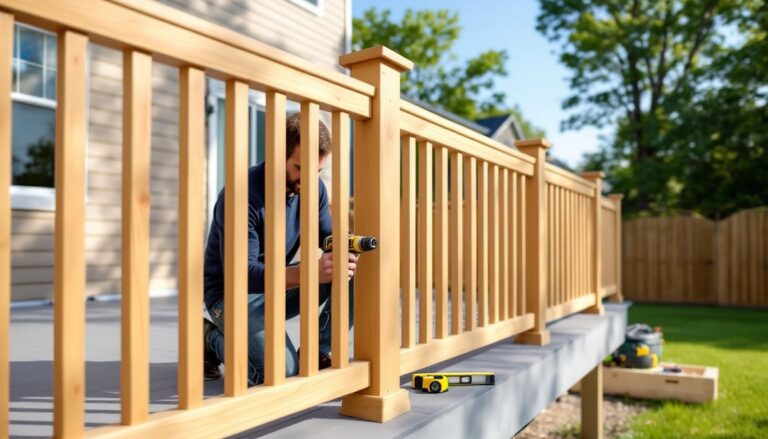
Deck framing uses the miter saw for cutting joist ends, rim boards, and angled deck board layouts. The DWS779’s capacity handles 2×10 joists at 90 degrees, making deck construction faster than marking and cutting each board with a circular saw. For diagonal deck board patterns, 45-degree miter cuts create clean transitions.
Picture frames and small woodworking projects benefit from the saw’s precision. Cutting four pieces to identical lengths with perfect 45-degree miters ensures tight corner joints. Use a stop block clamped to the fence to repeat cuts without re-measuring, cut one piece, clamp the stop block at the measured length, then cut the remaining three pieces against the stop.
DIY furniture projects like coffee tables, benches, or shelving units rely on accurate crosscuts and miters. A miter saw cuts table legs to uniform length, miters frame joints for a modern look, and handles angled cuts for tapered legs or splayed furniture bases. Hardwoods demand sharp blades and slow feed rates to avoid tear-out on the exit side of the cut.