Sectional sofas are the workhorses of family rooms and open-concept living spaces, but throw a chaise into the mix and you’ve got a piece that doubles as a napping sanctuary and a casual entertainment hub. A chaise sectional combines modular seating with an extended lounge, giving you more layout flexibility than a standard sofa without eating up the square footage of separate pieces. Whether you’re furnishing a cozy den or anchoring a sprawling basement, understanding how these configurations work, and what to look for in construction and fabric, will save you from buyer’s remorse and years of living with a piece that doesn’t quite fit.
Table of Contents
ToggleKey Takeaways
- A chaise sectional sofa combines modular seating with an extended lounge, offering flexible seating for 4–6 people while maximizing space efficiency in smaller rooms and open-concept layouts.
- When choosing a chaise sectional, measure clearances carefully, determine left or right-facing orientation based on your room’s focal points, and prioritize kiln-dried hardwood frames with high-density foam cushions for durability.
- Performance fabrics and proper upholstery construction—including eight-way hand-tied springs or properly spaced sinuous springs—ensure your chaise sectional maintains comfort and appearance for years.
- Strategic placement of your chaise sectional against walls or in corners improves traffic flow and visually anchors large spaces without requiring additional furniture pieces.
- Maintain your chaise sectional with weekly vacuuming, monthly cushion rotation, immediate spot-cleaning, and fabric-specific care to prevent stains, fading, and wear from pets or sunlight.
What Is a Chaise Sectional Sofa and Why Choose One?
A chaise sectional sofa is a modular seating unit that includes at least one extended seat with a longer platform for reclining, essentially a built-in lounger attached to a traditional sectional frame. Unlike a standard sofa with uniform seat depth (typically 20–24 inches), the chaise portion extends 60–80 inches, allowing someone to stretch out fully.
The appeal comes down to versatility and space efficiency. Instead of buying a sofa plus a separate chaise lounge or ottoman, you get both functions in one footprint. This makes them ideal for studio apartments, bonus rooms, or any space where you want maximum seating without crowding the floor.
Chaise sectionals also define zones in open-concept layouts. Place one perpendicular to a kitchen island or facing a media wall, and it naturally carves out a living area without the need for room dividers. The L-shape or U-shape configurations create a cozy, enclosed feeling that works well for families or anyone who entertains regularly.
Key Benefits of Chaise Sectional Sofas for Modern Living Spaces
Flexible seating capacity is the first advantage. Most chaise sectionals seat four to six comfortably, with the chaise itself accommodating one full-length lounger or two people sitting upright. That’s more efficient than a traditional three-seat sofa paired with a loveseat.
Traffic flow improvement is often overlooked. Because the chaise section hugs a wall or corner, you free up walkways in the center of the room. This is especially useful in narrow or galley-style living rooms where a floating sofa would block movement.
Napping and relaxation are built in. The extended chaise provides a spot to fully recline without needing to commandeer the entire sofa, a game-changer for households with kids, remote workers taking midday breaks, or anyone recovering from a long day on their feet.
Visual anchoring matters in large or awkwardly shaped rooms. A chaise sectional has enough mass to ground a space without requiring additional furniture. Pair it with a coffee table and a couple of side tables, and you’ve got a complete seating arrangement that feels intentional, not sparse.
Many homeowners discussing their experiences with chaise sectionals note that the functionality outweighs the footprint, especially in family-heavy households where seating turnover is high.
How to Choose the Right Chaise Sectional Configuration for Your Room
Start by measuring your room, not just wall-to-wall dimensions, but also clearances around doorways, windows, and heating vents. A chaise sectional needs at least 30–36 inches of clearance in front for comfortable legroom and traffic flow. If you’re placing it in a corner, confirm that the chaise won’t block a door swing or obstruct a radiator.
Next, map out your primary sight lines. Where’s the TV? The fireplace? The best window view? The sectional should orient toward your focal point, with the chaise positioned to maximize lounging comfort without forcing awkward neck angles.
Consider modular vs. fixed-frame construction. Modular sectionals use connectors or clips to join independent pieces, so you can reconfigure or separate them if you move or rearrange. Fixed-frame sectionals are built as a single unit (or two large pieces), which often means sturdier construction and fewer gaps between cushions, but zero flexibility.
Don’t ignore scale. A chaise sectional with deep seats (28+ inches) and high arms will feel bulky in a room with 8-foot ceilings. Look for low-profile arms (track arms, English arms) and shallower seat depths if your space is compact.
Left-Facing vs. Right-Facing Chaise: Which Orientation Works Best?
This terminology confuses a lot of first-time buyers. Left-facing means the chaise extends to the left when you’re sitting on the sofa facing forward. Right-facing is the opposite. To confirm which you need, stand where you plan to place the sectional and face into the room, the chaise should extend toward your dominant seating or viewing area.
If your room has an asymmetrical layout, say, a fireplace on one side and a bank of windows on the other, place the chaise on the side with more open floor space. This prevents the chaise from jutting into a walkway or blocking natural light.
For corner placements, the chaise typically goes on the side farthest from the room’s main entry point. This keeps the sofa portion visible and accessible when someone walks in, while the chaise tucks into the corner for a more enclosed feel.
If you can’t decide, some manufacturers offer reversible chaise configurations with a floating ottoman that can attach to either side, helpful if you anticipate moving or redecorating within a few years.
Materials, Fabrics, and Upholstery Options: What to Consider
Frame construction is your foundation. Look for kiln-dried hardwood frames (oak, maple, or engineered hardwood) joined with dowels, corner blocks, and wood glue, this is standard in mid-to-high-end sectionals. Avoid frames made entirely of particleboard or softwood: they’ll sag and creak within a couple of years.
Cushion fill dictates comfort and longevity. High-density polyurethane foam (1.8–2.0 lb/ft³ density) holds its shape best and is common in the seat cushions. Back cushions often use a blend of foam and polyester fiber for a softer, more relaxed feel. Some premium models include down-blend wraps over foam cores, giving you the plushness of down without the constant fluffing.
Spring systems matter if you want lasting support. Eight-way hand-tied springs are the gold standard but add cost. Sinuous (S-shaped) springs are more common in mid-range sectionals and perform well if they’re properly spaced (4 inches or less apart) and run front-to-back as well as side-to-side.
For upholstery, performance fabrics are worth the premium if you have kids, pets, or eat on the sofa. Solution-dyed acrylic or polyester blends with stain-resistant treatments (Crypton, Sunbrella-style weaves) handle spills and wear better than cotton or linen. Leather and bonded leather are durable but require conditioning and can feel sticky in warm climates, top-grain leather ages gracefully, while bonded leather tends to peel after a few years.
Velvet and chenille look great in showrooms but show wear patterns quickly, especially on high-contact areas like armrests and seat edges. If you’re set on a plush fabric, ask about the double-rub count (abrasion resistance), anything above 25,000 double rubs is considered suitable for residential use: 40,000+ is commercial-grade.
Always request fabric swatches and test them at home under your actual lighting before committing. Colors and textures shift dramatically between store fluorescents and living room daylight.
Styling Your Chaise Sectional: Design Tips and Layout Ideas
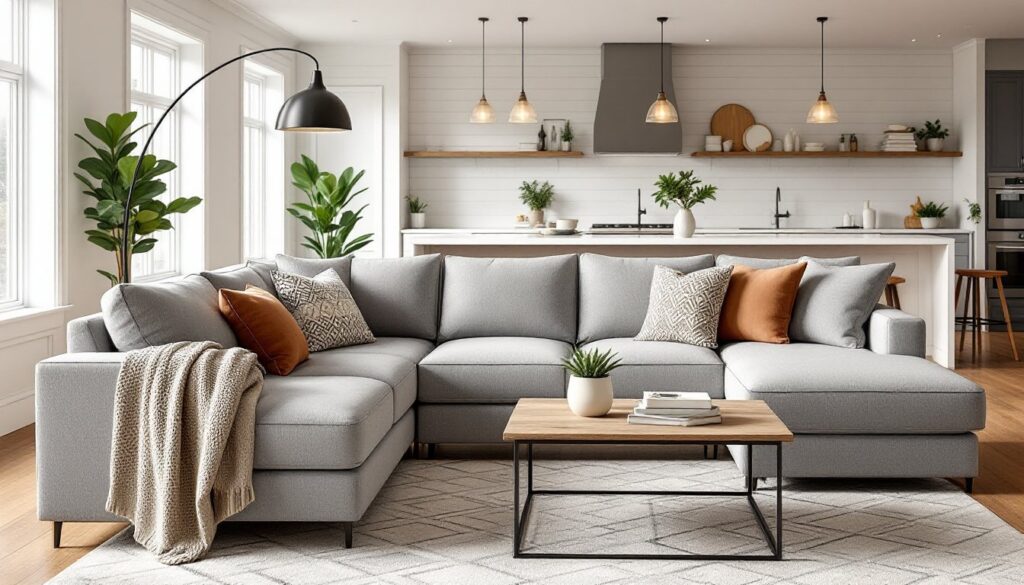
Start with a coffee table scaled to the sectional’s footprint. For an L-shaped chaise sectional, a rectangular or oval table works better than a round one, it mirrors the lines of the sofa and provides more usable surface area. Leave 14–18 inches between the table edge and the sofa cushions for comfortable reach.
Area rugs should extend at least 12 inches beyond the front legs of the sectional on all sides, or large enough to fit all furniture legs on the rug. This visually anchors the seating group. If your chaise sectional floats in the room (not against a wall), the rug becomes even more critical for defining the zone.
Balance the visual weight with accent chairs or side tables on the open end of the sectional. A single armchair perpendicular to the sofa arm creates a conversational cluster without blocking sightlines. If space is tight, a C-table or nesting tables next to the chaise provides a landing spot for drinks without taking up floor space.
Lighting layering helps, especially in open-concept spaces. A floor lamp behind the chaise or an arc lamp reaching over from the side adds task lighting for reading without requiring end tables. Wall sconces flanking a media console or fireplace balance overhead lighting and reduce glare on screens.
Pillows and throws add texture but don’t overdo it. Three to five throw pillows (mix of 18-inch, 20-inch, and a lumbar) keep it functional rather than fussy. Drape a throw over the chaise arm or along the back rather than folding it into a stiff rectangle.
For small-space layouts, design experts at Apartment Therapy often recommend floating the sectional a few inches off the wall to create breathing room and prevent the space from feeling cramped, counterintuitive, but it works.
Maintenance and Care Tips to Keep Your Chaise Sectional Looking New
Vacuum weekly using the upholstery attachment to pull out crumbs, pet hair, and dust from crevices and under cushions. Flip and rotate cushions every month if they’re reversible, this evens out wear and prevents permanent body impressions.
Spot-clean spills immediately with a clean, damp cloth and blot (don’t rub) from the outside in to avoid spreading the stain. For performance fabrics, a solution of mild dish soap and water works for most food and drink spills. Test any cleaner on an inconspicuous area first, inside a cushion zipper or under a skirt, before applying it to visible upholstery.
For deeper cleaning, check the care tag. W means water-based cleaner only: S means solvent-based (dry-clean) only: WS means either is safe: X means vacuum only (usually for delicate or non-colorfast fabrics). Rent a upholstery steam cleaner once or twice a year if the manufacturer allows it, or hire a professional if you have high-end fabric or tufted details that trap dirt.
Leather and faux leather need different care. Wipe leather monthly with a damp cloth, then apply a leather conditioner every 6–12 months to prevent cracking. Bonded leather and vinyl can’t absorb conditioner, just wipe with a damp cloth and avoid harsh cleaners that degrade the coating.
Keep the sectional out of direct sunlight if possible. UV exposure fades fabric and dries out leather. If your sectional sits near a west-facing window, consider sheer curtains or UV-blocking window film.
Pet owners: trim pet nails regularly to minimize fabric snags, and use washable furniture covers or throws on high-traffic sections. Enzyme cleaners work best for pet accidents, they break down odor-causing proteins rather than just masking the smell.
If your sectional has removable covers, follow washing instructions carefully. Most require cold water, gentle cycle, and air drying to prevent shrinkage. Don’t assume you can toss them in the dryer, heat sets wrinkles and can warp elastic or piping.
For ongoing inspiration and seasonal maintenance reminders, home design resources like HGTV offer practical checklists that adapt to different fabric types and household situations.