Designer kitchen cabinets aren’t just about a higher price tag, they’re about craftsmanship, superior materials, and details that turn a functional kitchen into the room everyone wants to gather in. Whether someone’s gutting an outdated ’90s kitchen or upgrading builder-grade boxes, understanding what separates designer cabinets from big-box offerings helps homeowners make smarter renovation decisions. From dovetail joinery to soft-close hinges and custom finishes, these cabinets deliver both visual impact and decades of reliable performance. This guide breaks down what defines designer quality, explores trending styles, examines materials, and offers practical strategies for achieving a high-end look without blowing the budget.
Table of Contents
ToggleKey Takeaways
- Designer kitchen cabinets distinguish themselves through superior joinery methods like dovetail joints, quality hardware with soft-close hinges, and multi-coat finishes that resist moisture and UV fading far better than mass-market alternatives.
- Shaker-style and sleek European frameless designs dominate 2026 trends, with designer kitchens shifting toward bold colors like navy and forest green, matte finishes, and hardware featuring unlacquered brass or matte black.
- Plywood construction with solid wood face frames outperforms particleboard by resisting moisture and maintaining structural integrity through decades of daily use, making it a core investment in quality cabinets.
- Semi-custom cabinets offer the best value for most homeowners, delivering designer-grade construction with 30-50% cost savings and 6-10 week lead times compared to fully custom work.
- Strategic upgrades like hardware swaps, quality paint, refacing existing boxes, and architectural details like crown molding let homeowners achieve designer cabinet aesthetics without full replacement costs.
What Makes Kitchen Cabinets ‘Designer’ Quality?
Designer kitchen cabinets distinguish themselves through construction techniques, hardware quality, and finish precision that mass-market options rarely match. The difference starts inside the box.
Joinery methods separate decent cabinets from exceptional ones. Look for dovetail or mortise-and-tenon joints on drawer boxes instead of staples or butt joints held with glue. These traditional techniques handle decades of daily use, opening, closing, loading dishes, without loosening or failing. Many designer lines use plywood box construction with solid wood face frames rather than particleboard, which resists moisture and maintains structural integrity longer.
Hardware quality matters more than most homeowners realize. Designer cabinets typically include soft-close hinges and full-extension drawer slides rated for 75+ pounds, not the lightweight undermount slides found in budget cabinetry. European manufacturers like Blum and Grass dominate this space with hydraulic mechanisms that prevent slamming and ensure smooth operation for 15-20 years. Check weight ratings and cycle testing, quality hardware is tested to 100,000+ cycles.
Finish work on designer cabinets involves multiple coats of catalyzed varnish or conversion varnish, not basic paint or stain. These finishes resist scratches, moisture, and UV fading far better than standard polyurethane. Inspect door edges and interior surfaces, designer cabinets finish all sides, not just what’s visible when doors are closed. Many cabinet design collections showcase these construction details through close-up photography.
Customization options expand dramatically at the designer level. Expect choices in door profiles, wood species, stain matching, interior configurations, and integrated lighting or charging stations, features that transform cabinets from storage into tailored solutions for how a household actually cooks and lives.
Top Designer Kitchen Cabinet Styles for Modern Homes
Two dominant styles currently define designer kitchen cabinetry, each offering distinct aesthetic and functional advantages. Both work in contemporary homes but serve different design philosophies.
Shaker Cabinets with a Luxury Twist
Shaker-style cabinets remain the most requested design for good reason, clean lines, a recessed center panel, and versatile proportions work in farmhouse, transitional, and even modern kitchens. Designer versions elevate the basic form through wider frame rails (3-4 inches instead of the standard 2-2.5 inches), creating more substantial visual weight. Premium details include beaded inset construction where doors sit flush within the face frame rather than overlaying it, requiring precise tolerances and adding 20-30% to costs.
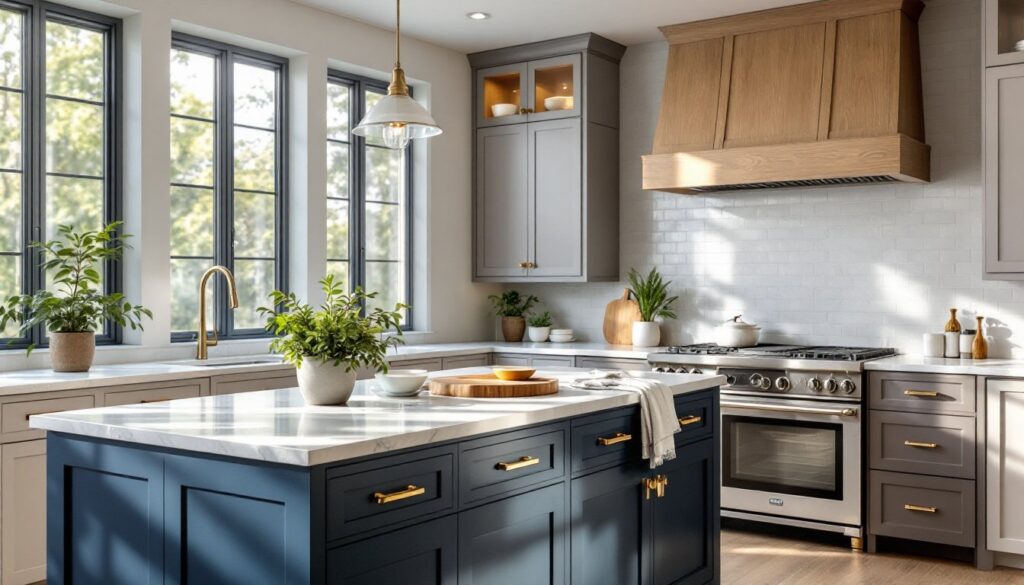
Color choices moved beyond white. Deep navy, forest green, charcoal, and warm taupe dominate designer Shaker kitchens in 2026, often paired with contrasting islands or open shelving in natural wood. Matte and satin finishes replaced glossy lacquer, hiding fingerprints while maintaining easy cleaning. Hardware shifted toward unlacquered brass, matte black, or leather pulls, anything with texture and patina potential.
Two-tone Shaker kitchens offer design flexibility without full commitment. Consider darker lowers with lighter uppers, or vice versa, to define zones in open-plan spaces. Just keep the door style consistent, mixing profiles looks disjointed, not intentional.
Sleek European Frameless Designs
Frameless (full-overlay) cabinets eliminate the face frame entirely, with doors covering the entire cabinet box. This European approach maximizes interior space, drawers and shelves run nearly the full width of the cabinet, and creates seamless horizontal lines across multiple doors. The look reads ultra-modern and minimalist, perfect for contemporary or industrial-style kitchens.
Designer frameless cabinets feature integrated handles (J-channels or beveled edges milled into doors) or push-to-open mechanisms, eliminating visible hardware. High-gloss acrylic or thermofoil finishes in pure white, concrete gray, or matte black dominate this style, though wood veneer options exist for warmer takes. Grain matching across adjacent doors, called book-matching, demonstrates premium attention to detail that distinguishes custom work from production lines.
Installation requires more precision than face-frame cabinets. Without a frame to hide gaps, frameless designs demand level floors, plumb walls, and accurate measurements. Homeowners examining extensive design galleries will notice frameless kitchens often incorporate floor-to-ceiling storage and handleless designs that emphasize clean geometry.
Materials That Define Designer Kitchen Cabinets
Material selection impacts both longevity and aesthetics more than any single design decision. Designer cabinets use premium substrates and veneers that justify their cost through performance.
Hardwood species remain the gold standard for door and face frames. Maple, cherry, walnut, and white oak lead designer kitchens, each offering distinct grain patterns and staining characteristics. Maple’s tight, uniform grain takes paint beautifully and resists denting, ideal for high-traffic kitchens with kids. Walnut’s rich brown tones and dramatic grain need minimal finishing, often just clear coat to preserve natural color. White oak’s prominent ray fleck and open grain suit both modern and traditional aesthetics when treated with cerused or wire-brushed finishes that emphasize texture.
Avoid red oak in designer applications, its pronounced grain and orange undertones feel dated compared to white oak’s cooler tones. Similarly, hickory’s extreme grain variation works in rustic settings but clashes with refined designer details.
For cabinet boxes, plywood beats particleboard in every measurable way. 3/4-inch maple or birch plywood handles weight, resists sagging, and holds screws through multiple adjustments. Particleboard (even the upgraded stuff marketed as “furniture board”) swells when exposed to moisture from dishwashers, sinks, or humidity. Designer manufacturers often upgrade to formaldehyde-free plywood meeting CARB2 or TSCA Title VI standards, better for indoor air quality and increasingly required by building codes.
Engineered materials do have a place in designer work. MDF (medium-density fiberboard) painted doors deliver glass-smooth surfaces without wood grain telegraphing through, perfect for high-gloss or matte paint finishes. Just ensure MDF use stays above counter level, away from potential water exposure.
Exotic veneers offer dramatic visual impact at lower cost than solid exotic wood. Quartersawn oak, figured walnut, and zebrawood veneers applied to plywood substrates provide the beauty of rare species with better dimensional stability than solid wood. Properly applied veneers won’t delaminate and actually reduce waste compared to milling solid exotics.
Custom vs. Semi-Custom Designer Cabinets: Which Should You Choose?
The terms “custom” and “semi-custom” get thrown around loosely, but they represent fundamentally different manufacturing processes with distinct cost and timeline implications.
Semi-custom cabinets start with a manufacturer’s standard line, specific door styles, box sizes (typically 3-inch width increments), and finish options, but allow modifications. Homeowners choose from predetermined door profiles, select wood species from available options, adjust heights by several inches, and specify interior accessories like pull-out trash bins or spice racks. Lead times run 6-10 weeks, and costs fall 30-50% below true custom work. Quality varies widely, some semi-custom manufacturers deliver designer-grade construction, while others simply charge more for particleboard boxes with slightly better hinges.
Reputable semi-custom brands include KraftMaid, Medallion, and Wellborn, which offer plywood construction and quality hardware in their upper-tier lines. Don’t confuse semi-custom with “customizable” stock cabinets sold at big-box stores, those remain mass-produced with limited modification options.
Custom cabinets mean exactly what the name implies: built to order, to exact specifications, with virtually unlimited design options. A local cabinet shop or specialized manufacturer builds boxes to fit specific dimensions, critical for older homes with out-of-square walls or odd ceiling heights. Door styles can be created from scratch, wood can be sourced specifically for the project, and internal configurations suit the client’s cooking habits rather than a catalog’s standard options.
Custom work shines when dealing with challenging layouts, historic preservation requirements, or truly unique design visions. Expect 10-16 week lead times and costs 40-100% above semi-custom, depending on complexity and materials. Fully custom work makes sense for high-end renovations where cabinets need to match existing millwork, integrate unusual appliances, or achieve a specific historical style.
For most homeowners, semi-custom delivers the best value. Modern semi-custom manufacturers offer enough flexibility to accommodate standard kitchen layouts while maintaining quality construction. Reserve custom work for projects with genuine spatial challenges or design requirements that semi-custom lines can’t address. Either way, verify construction methods, request samples showing joinery and finish quality, and confirm hardware specifications before committing.
Budget-Friendly Ways to Achieve the Designer Cabinet Look
Designer aesthetics don’t always require designer budgets. Strategic choices and smart DIY efforts can bridge the gap between builder-grade and high-end appearance.
Upgrade hardware first. Swapping basic knobs and pulls for quality options transforms cabinet fronts immediately. Budget $8-15 per piece for solid brass or stainless hardware versus $2-3 for zinc alloy big-box versions. Unlacquered brass develops patina naturally (some love it, others prefer the maintenance of lacquered finishes), while matte black powder-coated hardware hides fingerprints and works across multiple styles. Measure existing boring (hole spacing), standard is 3 or 3.75 inches for pulls, before ordering to avoid new drilling.
Refacing beats replacing when cabinet boxes remain structurally sound but doors and drawer fronts look tired. Professional refacing applies new veneer to visible cabinet surfaces and installs new doors, drawer fronts, and hardware. Costs run 30-50% of new cabinets with similar visual impact. DIY refacing is possible with peel-and-stick veneer or paint, though doors benefit from professional spray finishing for truly smooth results. Remove doors, label them carefully, and rent an HVLP sprayer for best paint results, brush marks telegraph immediately on large flat surfaces.
Paint strategically. A quality paint job on existing cabinets requires proper prep, cleaning grease with TSP substitute, light sanding with 220-grit paper, and bonding primer designed for slick surfaces. Many homeowners exploring design inspiration resources discover that bold paint colors on lowers with white uppers mimics expensive two-tone designer kitchens without the custom cabinet investment. Use catalyzed enamel or cabinet-specific paint (Benjamin Moore Advance, Sherwin-Williams Emerald Urethane), not wall paint, for durability.
Mix sources. Designer-level islands don’t require designer-level perimeter cabinets. Splurge on a statement island with premium finishes and details while using quality semi-custom boxes for wall cabinets. The island draws attention, and most people won’t notice different construction methods for upper storage.
Add architectural details. Crown molding, furniture-style base legs, and decorative end panels elevate basic cabinets. Applied molding and trim pieces cost relatively little but add visual complexity that reads as custom work. Just ensure proportions match, oversized crown on short uppers looks awkward, not elegant.
Finally, prioritize visible upgrades. Glass-front uppers with interior lighting showcase dishes while hiding basic box construction behind nice door frames. Open shelving in select areas breaks up solid cabinet runs and allows display of attractive items, both designer trends achievable in any budget.
These strategies let homeowners achieve much of the designer aesthetic while reserving budget for where it truly matters: durable construction, quality hardware, and finishes that withstand daily use for years.