When a Broan range hood stops venting properly or the lights flicker out during dinner prep, the problem usually isn’t the whole unit, it’s one or two worn-out parts. Most homeowners don’t realize how straightforward it is to replace individual components instead of shelling out hundreds for a full hood replacement. Broan designs their hoods with DIY repairs in mind, offering readily available replacement parts that can extend the life of a unit by years. Whether dealing with a clogged filter, a burned-out motor, or a cracked light lens, knowing which parts for Broan range hood systems are available and how to source them saves both time and money.
Table of Contents
ToggleKey Takeaways
- Broan range hood parts like filters, motors, and capacitors can be replaced individually to extend unit lifespan and save hundreds compared to full hood replacement.
- The model number found on the hood’s interior tag is essential for ordering correct Broan range hood parts, as components aren’t always compatible across different production years.
- Common replacement components include mesh or charcoal filters (replaced every 3-6 months), blower motors ($80-$200), and capacitors ($10-$15 for quick fixes when motors hum but won’t spin.
- Always turn off power at the breaker and verify with a voltage tester before replacing Broan range hood parts internally, and take photos of wire configurations before disconnecting any electrical components.
- Purchase genuine OEM parts from Broan’s official portal or reputable retailers like RepairClinic for critical components like motors, but generic mesh filters work fine if dimensions match exactly.
Understanding Your Broan Range Hood System
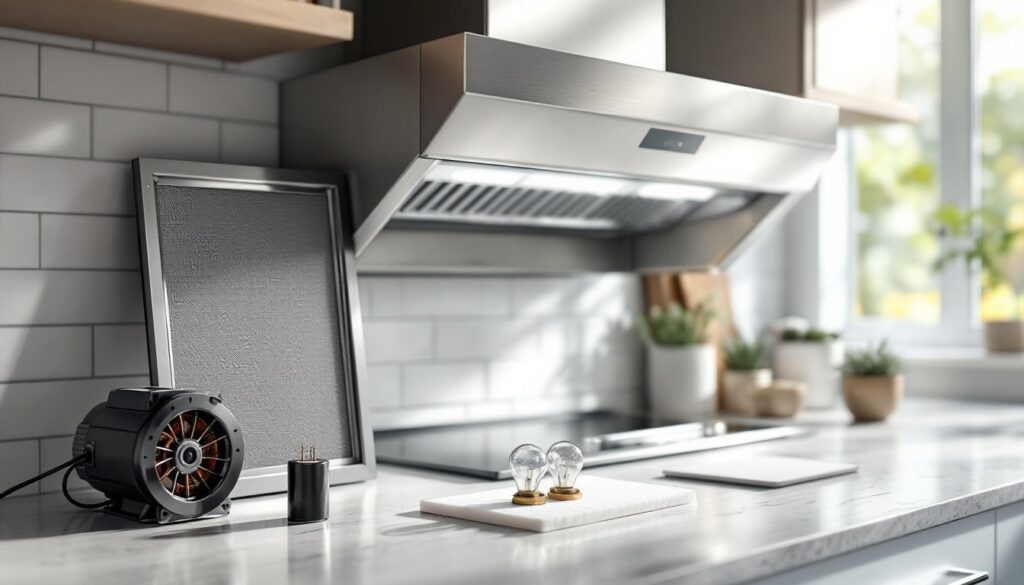
A Broan range hood is more than just a metal canopy over the stove. The system typically includes several key components working together: a blower or fan assembly that creates suction, a duct or ductless ventilation path, filters that trap grease and odors, a lighting system for task illumination, and electrical controls ranging from basic switches to touch panels.
The blower assembly sits at the heart of the system, either mounted internally (inside the hood cabinet) or externally (in the attic or outside wall). Internal blowers are quieter but harder to service: external units push more CFM (cubic feet per minute) but require longer duct runs. Most residential Broan hoods use centrifugal blowers rated between 150-600 CFM depending on cooktop size and BTU output.
Filters come in two main types: mesh grease filters (aluminum or stainless steel) and charcoal filters for recirculating ductless models. Mesh filters are washable and should last years if maintained: charcoal filters are disposable and need replacement every 3-6 months depending on cooking frequency. The lighting system typically uses halogen or LED bulbs, though older models may still have incandescent fixtures.
Electrical components include capacitors (for motor startup), switches or touchpads, and sometimes speed control modules. These parts fail less often than filters and blowers but can cause total system failure when they do. Understanding how these pieces interact helps diagnose problems accurately, a hood that runs but doesn’t vent might have a clogged filter rather than a motor issue.
Most Common Broan Range Hood Parts That Need Replacement
Filters and Filter Accessories
Grease filters take the brunt of everyday cooking abuse. Aluminum mesh filters are the most common type in ducted Broan hoods, they’re dishwasher-safe but get clogged with carbonized grease if not cleaned monthly. When the mesh starts sagging, tearing, or has holes worn through, replacement is the only fix. Original Broan filters fit specific model cutouts, so measure the filter frame dimensions before ordering (typical sizes range from 8″x9″ to 11″x13″).
Charcoal filters (also called carbon or recirculating filters) fit ductless models and can’t be cleaned, they’re single-use. These filters look like thick fabric pads or honeycomb cartridges and sit behind the grease filter. When cooking odors start lingering even though a clean grease filter, the charcoal filter is saturated. Broan uses model-specific charcoal filters: universal alternatives rarely fit properly or seal correctly.
Filter accessories include the filter latches and clips that secure filters in place. These plastic or metal tabs break easily during filter removal, especially on older units. Replacement clips cost a few dollars but prevent filters from rattling or falling during operation.
Blower Motors and Fan Assemblies
Blower motors fail for three main reasons: bearing wear (causing grinding noise), capacitor failure (motor hums but doesn’t spin), or burnt windings (motor won’t start at all). Broan uses different motor types depending on CFM rating, smaller units (under 300 CFM) typically have single-speed PSC (permanent split capacitor) motors, while larger units use multi-speed motors with separate speed control modules.
Replacing just the motor is possible if the fan wheel (the squirrel-cage blower) is still intact. The wheel attaches to the motor shaft with a set screw, if it’s bent, unbalanced, or has broken blades, it needs replacement too. Fan wheels are sold separately or as part of a complete blower assembly.
Blower assemblies (motor plus housing plus wheel) simplify replacement when multiple components are worn. These assemblies come pre-assembled and often include mounting brackets. Expect to pay $80-$200 depending on CFM rating and whether it’s an internal or external mount unit. Checking appliance reviews from Good Housekeeping can help verify replacement part quality before purchasing.
Capacitors are small cylindrical components mounted near the motor. They store electrical charge to help the motor start. A failed capacitor is one of the easiest fixes, they’re $10-$15 parts that require only two wire connections. If the motor hums but doesn’t spin, test or replace the capacitor before replacing the whole motor.
How to Identify the Right Parts for Your Broan Model
The model number is the key to ordering correct parts. Broan stamps this on a metal tag inside the hood, usually on the interior side wall or along the filter frame. It’s a combination of letters and numbers (like “E64E36SS” or “413004”) that identifies not just the model but often the production series.
Once the model number is located, cross-reference it with Broan’s parts diagrams. These exploded-view drawings show every component and its part number. Broan’s official site hosts these diagrams, as do appliance parts retailers. The diagrams are crucial, what looks like a simple light cover might have three different versions depending on hood vintage.
Parts for Broan range hood systems aren’t always backward-compatible across model years. A filter from a 2015 model might not fit a 2010 hood even if they look identical. Hood depth, filter rail spacing, and latch styles vary. When ordering, provide both the model number and the specific part number from the diagram.
If the model tag is painted over or corroded, measure existing parts carefully. For filters, measure the frame opening (not the filter itself). For motors, note the mounting bolt pattern, shaft diameter, and electrical specs (voltage, amperage, RPM). Many parts retailers offer identification help if you provide photos and measurements.
After a home renovation project detailed by This Old House, homeowners often upgrade hood exteriors but keep the internal components, this can make identification trickier since the visible hood doesn’t match the internal parts model. Always verify the internal components’ model tags separately.
Where to Buy Genuine Broan Range Hood Parts
Broan’s official parts portal is the gold standard for OEM (original equipment manufacturer) parts. They guarantee fit and offer exploded diagrams for most models dating back 20+ years. Shipping is typically $8-$15 flat rate, which makes sense when ordering multiple parts at once.
Appliance parts retailers like RepairClinic, PartSelect, and AppliancePartsPros carry extensive Broan inventories. These sites often have better search tools than Broan’s site, with filter options for part type, symptom, or model series. They also stock aftermarket alternatives, third-party filters or generic motors that fit Broan mounts. Aftermarket parts cost 30-50% less but may have shorter lifespans.
Big-box home improvement stores (Home Depot, Lowe’s) carry common Broan parts in-store: mesh filters, charcoal filters, light bulbs, and sometimes blower assemblies for popular models. The advantage is immediate availability: the downside is limited selection. If the local store doesn’t stock a part, they can usually special-order it with 3-7 day delivery.
HVAC supply houses serve contractors but also sell to homeowners. They stock blower assemblies, motors, and ductwork accessories. Pricing is often wholesale, especially if buying multiple parts. Call ahead, some require a contractor license or business account.
Amazon and eBay have broad inventories, including discontinued parts from third-party sellers. This is the best source for older models (10+ years) where official channels have depleted stock. Read seller ratings carefully and verify part numbers match exactly. Return policies vary widely.
For critical parts like motors or control boards, stick with OEM or reputable aftermarket brands. Cheap knockoff motors often use inferior bearings and burn out quickly. Filters are more forgiving, generic mesh filters work fine if dimensions match. Resources like The Kitchn’s appliance guides often recommend trusted parts suppliers based on reader experience.
DIY Installation Tips for Replacing Broan Range Hood Components
Always cut power at the breaker before working on range hood internals. Most hoods are hardwired to a 120V circuit: some newer models use plug connections. Verify power is off with a non-contact voltage tester, don’t rely on the wall switch alone.
Replacing filters requires no tools. Mesh filters slide or pivot out after releasing spring clips or latches. Note the orientation, there’s usually a front and back edge. Charcoal filters snap into clips behind the grease filter: press the release tabs and pull straight down.
Blower motor replacement is intermediate-level work. After killing power, remove the filter and blower cover (usually 4-6 screws). Disconnect the wire harness (label wires with tape if there are multiple connections). Remove mounting bolts holding the motor or blower assembly, these are typically ¼” or 5/16″ hex heads. If replacing just the motor, loosen the set screw on the fan wheel and slide it off the old motor shaft. Transfer it to the new motor shaft and tighten the set screw snugly (but don’t overtighten, you’ll strip the soft aluminum).
New motors may include a capacitor: if not, reuse the existing capacitor unless it’s failed (swollen or leaking). Capacitors store voltage even when power is off, short the terminals with an insulated screwdriver before handling. Reconnect wires to the new motor (match wire colors or reference the wiring diagram). Secure the motor, test for proper rotation (it should spin smoothly without wobble), then reinstall covers and filters.
Light component replacement is straightforward. Bulbs unscrew or pull out of sockets (halogen bulbs use a quarter-turn bayonet base). Replace with same wattage and type, mixing LED and halogen in a multi-bulb fixture can cause uneven lighting. Light lenses snap off or screw on. If a socket is corroded, replacement sockets are sold individually and mount with two screws.
Control board or switch replacement requires matching wire positions exactly. Take a photo before disconnecting anything. Control boards mount with screws and a plug harness: switches usually have spade terminals. If converting from mechanical switches to touchpad controls, verify the replacement is compatible, some require different wiring configurations.
Test the repair before fully reassembling. Restore breaker power and run each function. Listen for unusual noise (loose fan wheel), check airflow at the duct exit, and verify lights work. If everything runs correctly, reinstall covers and filters. Most repairs take 30-60 minutes once parts are on hand.
When to call a pro: If ductwork is damaged, the hood is loose from the wall, or there’s electrical damage beyond the hood itself, hire a licensed electrician or HVAC tech. Structural modifications or changes to duct routing may require permits depending on local codes.